We remain fully operational. Our teams are working around the clock to ensure your deliveries continue safely.

DOWNLOAD THE APP


Copyright © 2025 Desertcart Holdings Limited
DOWNLOAD THE APP




Buy anything from 5,000+ international stores. One checkout price. No surprise fees. Join 2M+ shoppers on Desertcart.
Desertcart purchases this item on your behalf and handles shipping, customs, and support to Burundi.
🚀 Blast dust away like a pro — keep your gear pristine, always!
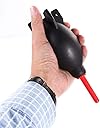
The Giottos AA1900 Rocket Air Blaster Large is a 7.5-inch rubber air blower featuring a 2.25-inch nozzle and a one-way valve to prevent dust re-entry. Designed for photographers and tech enthusiasts, it delivers powerful, precise bursts of air to safely remove dust and debris from cameras, lenses, keyboards, and other sensitive equipment. Its durable construction and ergonomic design make it a reliable, must-have tool for maintaining pristine gear and ensuring optimal performance.
| ASIN | B00017LSPI |
| Best Sellers Rank | #2 in Camera & Photo Compressed Air |
| Brand | Giottos |
| Brand Name | Giottos |
| Customer Reviews | 4.7 out of 5 stars 10,522 Reviews |
| Global Trade Identification Number | 02000000147666, 04715412009256 |
| Item Dimensions W x H | 2.4"W x 7.5"H |
| Item Weight | 90 Grams |
| Manufacturer | Giotto |
| Number of Pieces | 1 |
| Product Dimensions | 2.4"W x 7.5"H |
| UPC | 411378016317 398652365890 077349249872 775149574735 |
| Volume | 400 Milliliters |
| Warranty Description | 1 Year |
D**N
Great tool
I purchased this over a year ago and have been using it whenever I want to blow dust off my tech and gear. As an avid photographer and a stickler for maintaining my camera gear in pristine condition, the Giottos Rocket Air Blaster has become an indispensable tool in my kit. This unassuming yet powerful dust blower has revolutionized the way I clean my camera equipment, and I can confidently say it's a must-have accessory for anyone serious about keeping their gear spotless. Design and Build Quality: The Giottos Rocket Air Blaster's design is cleverly inspired by a rocket, and it's not just for aesthetics. The elongated nozzle resembles the rocket's nose, making it easy to reach into tight spaces and crevices without causing any damage. The overall build quality is exceptional, featuring robust materials that ensure durability over time. The rubber bulb is easy to squeeze, providing a steady and controlled stream of air without any leaks or inconsistencies. Performance and Effectiveness: When it comes to removing dust and debris from delicate camera lenses, sensors, and other equipment, the Giottos Rocket Air Blaster performs like a champ. Its powerful burst of air is more than sufficient to blow away even the tiniest particles without the need for physical contact, reducing the risk of scratches or damage to sensitive coatings. The blower's air intake valve prevents dust from being sucked back into the nozzle, ensuring that the cleaned areas stay pristine. Portability and Convenience: The Giottos Rocket Air Blaster's lightweight design makes it portable but the large size comes with space challenges depending on how big your camera bag is. I carry a Peak Design Everyday Sling 5L so the blaster stays at home since I don't like to carry bulky bags but I could buy a smaller blaster if I wanted to carry it around. I ultimately chose the larger one so that I could get more air to come out per squeeze and thus have more force to push dust away. Seeing how much I use the large size, I might buy the smaller size so I have something to carry around. User-Friendly: One of the standout features of this blower is its straightforward operation. The ergonomic design of the Rocket Air Blaster ensures a comfortable grip, allowing for precise and targeted bursts of air. Value for Money: While the Giottos Rocket Air Blaster might be priced slightly higher than other air blowers on the market, the performance and build quality more than justify the investment. It has proven to be a reliable and effective tool, extending the lifespan of my camera gear and ensuring consistently clean shots. Conclusion: In conclusion, the Giottos Rocket Air Blaster is an outstanding product that lives up to its reputation as a top-tier dust blower for camera gear. Its excellent performance, user-friendly design, and durable build make it a worthwhile investment for both amateur and professional photographers alike. If you're serious about maintaining your camera equipment and want to ensure the best possible image quality, this little rocket blower will undoubtedly blast away your cleaning woes. Highly recommended!
A**N
Blows Away the Dust From Underneath the Keyboard Keys
Giotto makes the best hand-held airblowers (in my experience.) In this case it’s being used to blow dust out of a laptop keyboard. If you compare it to another brand to blow the same piece of paper, this will send that paper farther away. I have used another Giotto to blow dust off camera lenses and it works great. The rubber used is just soft enough to provide an easy squeeze, and solid enough to provide a strong burst of air. One more thing: hold the keyboard upside down over a towel to let the dust fall away from the keyboard while you blow on it. You may need to have someone hold the keyboard while you squeeze the Giotto. BONUS: You may also build up your hand muscles in the process!
G**E
i shouldnt but i love it
unironically worth the price, theres a lot of inflated cool factor for those that think they need this.. but its actually functionally better. more airflow volume, it will last longer, and it doubles as a great stress toy. sounds ridiculous but i wouldnt mind dropping $20 for another one.
S**K
Just Got Mine (Large) - Been Using Hand Powered Air Blasters for Years
Okay, so I just got my Large Rocket Air Blaster (filter reviews for your size if you need to), and I thought I'd come here and drop some science. Right off the bat, it's large, enough so that if you've got a cramped camera bag or not a lot of space, you may want to consider another size or another duster. It's got some great little 'advances' like the holes to hang it from your lanyard/neck if you're assisting on set, or are doing a lot of lens switches on a shoot and want to have it handy -- nice! This is also one of those things I misplace often (I've had the same blaster -- albeit another brand -- for the last 3 years before it got lost) so it's nice to be able to hang it somewhere in the studio, right next to the scanner. One thing that stood out to me, well, two things -- first the rubber on it is a little more 'brittle' or hard feeling than other brands. Coming here and reading reviews that mention theirs fell apart or began cracking just sitting around in a drawer (out of the sun) don't make me feel too positive about my new purchase. Next, there's a serial number stick on the stem of this thing (not shown in pics). I am guessing this is there because enough dishonest/gross people ran the ol' switcharoo on these -- perhaps buying a new one, then placing their old one in the package and returning it, claiming it arrived cracked. If I'm wrong, I'm sorry, but I've never seen an air blaster with a serial number on it... maybe it's for a warranty or something, who knows? The last thing that kinda irked me, was reading that the price was $7 in 2013 (see 2-star review by LuvLeaf in June of '13).... I paid $17 for mine (Large) in 2020... so maybe that's just inflation? Overall, I dunno if I'll be keeping this or sending it back. I did fine with the Altura 'Kit' Blower for lenses and screen dust over the last few years and that runs $12-13 + you get a bunch of extra stuff in the kit... For those of you saying it doesn't move a lot of air, no it's not compressed air. It does however move a lot of air for a hand-blower due to it's large bulb. Give it solid and fast squeezes and it'll blow harder and with more force. For those who want to blow air from your mouth onto your lenses (dunno why, but still), there is a RIGHT way to do it, so that you don't get spittle everywhere. First, place the lens at chin-level, way BELOW your mouth. Next place your hand flat across the front of your mouth -- near your mouth but not touching it... and be sure to place your lens (or whatever you're cleaning so that it's below & BEHIND your hand)... NOW BLOW a few times, quickly and with some good pressure. Adjust your distances/angle to redirect the air blast from your mouth across your lens/whatever you're cleaning in order to protect it from unwanted spit particles. Remember to wipe your lips and tighten them like you're playing a horn. Blow at your own risk of course, I use the method when I don't have a blower handy and it works like a charm. All in all, I will probably keep this... it does MOVE A LOT OF AIR... that said, I'm not 100% confident about it reading the reviews and feeling the hard(er) rubber for myself... guess we'll see how long it lasts just sitting on a dry climate controlled shelf. GIOTTOS if you're listening, it'd be awesome if you ran a check to see if there were other affordable rubber options available. I get that these have to be hard in order to stand up, but if they're cracking on people who are not abusing them, it may be time to reconsider the special brew. Aside from that, 4 out of 5, will come back and update this review if mine disintegrates.... lastly, on a side note, I do see that the folks who have had this thing begin to crack, have it cracking where the red tip meets the bulb (on the rubber lip there)... I wonder if rubber cement or some type of rubber sealant like E6000 would fix this... hopefully I never have to find out.
A**Y
Good item
Saw this item being used on you tube for cleaning records so I decided to try it. Works well!
T**T
My First Line of Defense for Sensors
I have an arsenal of weapons that I use for sensor cleaning. They include fluids, swabs, Sensorklear pens, brushes, and Sensorklear loupes. My first resort when a problem arises is my Giotto's blower. Because it requires no solid contact with the sensor, it is the least likely to do harm. The device blows hard enough to dislodge just about anything that isn't actually stuck to the surface or smeared onto the surface. It uses one-way valves (check-valves) so that it sucks air in the back end and blows it out the tube in front. The check valve on the rear probably serves to help filter the air. BTW, the use of canned compressed air or even dry nitrogen is not a good idea because its cold temperature can cause condensation, and if the can is held wrong it can actually spew liquid. I've read the reviews that say the blower just stirs up existing dust. The reviewers who claim that are actually in some good company. The professional camera book writer that I admire most makes the same point in some of his books, although I note that he may have come around lately. I have a simple approach to minimizing the stirring-up-dust problem. I turn the camera face down before I remove the lens or body cap. I hold it up high, still facing down so that I can see the sensor. Then I use the blower, being careful not to get the tip too close to the sensor. Next I replace the cover on the front of the camera. In this way, I let gravity help get any "blown-around" dust out. Honestly, though, if I had so much dust inside there that it would swirl around when I used a blower, I'd have to think I'd been pretty sloppy with camera care. Here is the sequence I follow with sensor cleaning: On cameras that have a sensor shaking capability, I leave the cap or lens on, turn the camera face down, and switch the cleaning mode on and off a few times. This shakes the sensor and sometimes removes the dust speck. Next, I try the blower. After that, I'll resort to a Butterfly brush. Next is the SensorKlear pen. Finally I'll use Eclipse fluid on a rectangular swab, typically with a piece of PecPad wrapped over the end. If I can't see the problem speck easily with the naked eye, I'll use a SensorKlear loupe to see how I'm doing. If it's not visible with the loupe, it's not going to show up on an image. Each of these approaches has compromises. The blower's compromises are that it can potentially stir up problems; it won't remove anything that is stuck or smeared on; and you have to be careful not to touch the sensor with the blower tip. The Butterfly brush can do damage if pressed down too hard so that the casing around the base of the bristles touches the sensor. If you let any brush touch anything other than the sensor, you will likely smear something onto the sensor. Even touching the inside of the camera can do this (trust me, I don't make this up). The SensorKlear Pen wipes the surface. Is it just rubbing the problem into the surface? Cleaning fluids can leave residue; they aren't perfect either, but they sure make a sensor look clean. Once, when I was forced to use cleaning fluid on a greasy smear on a sensor, I found that for weeks afterwards, the sensor seemed to attract dust. The problem was not Eclispe, it was the smeared-on compound. The problem went away after a month or so, perhaps because the residue finally outgassed away. Considering the alternatives I just covered, you can see why I tend to start with the Giotto's blower. It is quick and simple, and it is low-risk if you just be careful and methodical. It does double duty for lens filter cleaning, and it blows hard enough to be good for getting dust out of crevices in the camera body. If you don't have anything for camera cleaning, I recommend the blower as your first purchase. If you want to keep going, I'd go next to purchasing a loupe designed for sensor cleaning. The built-in lights on the loops are fantastic when it comes to making surface smears or debris show up. Good luck! Tim
M**U
I must go through the FURPS principle a) Functionality - to blow air (not aerosols - otherwise it will leave a film on your lens
At the end of the day, this is a very simple thing that does a very simple thing. However, as a reviewer, I must go through the FURPS principle a) Functionality - to blow air (not aerosols - otherwise it will leave a film on your lens) - not under super high pressure, and the jet of air cannot be super-cooled (otherwise your glass may crack). Does it do the work? Absolutely - Score = 100 b) Usability - Requirement: Should be easy and intuitive to use. The "body" of the blower is the right size... it fits the average hand well. Nozzle is the right size. The legs of the rocket make it stand up, and the nozzle does not fall off. Much appreciated. Nozzle size (length) is also good. Score > 85 c) Reliability - Looks well made, even though I do not have statistical data on how quickly the rubber ball will crack, but I have used other products from Giotto (which were well made), so I am going to give this the benefit of the doubt. Score = 85 d) Performance - This is measure of how quickly it can keep blowing. Since this is a manual device, the only sensible measurement is how quickly it can refill the ball by itself, once the pressure is released. I found the refill time to be quite quick, so I will score it at 90 e) Scalability - where can this device be used? Since this is a general-purpose photography device, it can be used on many things. Score 85 Well, if you ask me why I did not score it at a full 100, I would say there is something missing - and that is a detachable brush. Since most of us will use this to blow dust from our lenses, a brush would be good
A**A
Keeps your equipment clean of those pesky dust particles.
This is wonderfully versatile tool. And I am so grateful it is in my life. I purchased it to keep the SONY lenses on my new SONY a7r free of debris. It works beautifully. It has helped me immensely and many times when the breeze in sunny San Diego brought an unwelcome dust particle to my lens or lens filter. It blows off tiniest and larger particles immediately. It is an indispensable travel companion in my photo backpack and gets almost daily use. I trust it to blow off dust and debris and leave the lens or lens filter clean and clear. The valve built into the Rocket Air blaster prevents any dirty air from being expelled back onto the surface you are cleaning. What a great concept and extremely helpful. It is small enough to fit into my backpack or smaller photo bag, and can even be squished and folded to take up less space. I also use it to blow dust off my eyeglasses, computer equipment and so forth. A great tool to have and definitely indispensable. I totally recommend it for hobby and professional photographers alike. Pros: it is inexpensive; it's on prime delivery; it has a built-in valve to keep the dirty air away from your surfaced to be cleaned; it's small; it's foldable; it can stand and be stable on a flat surface; one handed operation, red tip to find it easily in your bag of tricks Cons: it's black so it sometimes gets 'lost' in a black bag with black equipment around it, luckily the red tip helps keep it visible :)
Trustpilot
1 month ago
4 days ago