We remain fully operational. Our teams are working around the clock to ensure your deliveries continue safely.

DOWNLOAD THE APP


Copyright © 2025 Desertcart Holdings Limited
DOWNLOAD THE APP


Buy anything from 5,000+ international stores. One checkout price. No surprise fees. Join 2M+ shoppers on Desertcart.
Desertcart purchases this item on your behalf and handles shipping, customs, and support to Burundi.
🔥 Instant Hot Water, Zero Compromise ⚡
The Rheem 6.5kW 240V Point of Use Thermostatic Tankless Electric Water Heater delivers endless, on-demand hot water with precise temperature control within 1°F. Its compact, wall-mountable design is 90% smaller than traditional tanks, saving valuable space. Energy-efficient operation heats water only when needed, reducing utility costs. Ideal for residential and light commercial use, it comes with a 1-year parts and 5-year leak warranty, supported by Rheem’s trusted USA-based customer service.

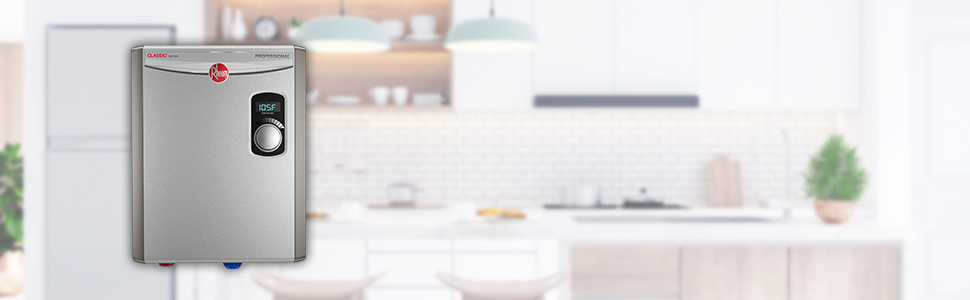









| ASIN | B0CJJXMCLJ |
| Best Sellers Rank | #5,816 in Tools & Home Improvement ( See Top 100 in Tools & Home Improvement ) #1 in Water Heaters |
| Brand | Rheem |
| Brand Name | Rheem |
| Capacity | 1.4 Gallons |
| Color | Gray |
| Customer Reviews | 4.2 out of 5 stars 3,954 Reviews |
| Efficiency | Highly Efficient |
| Flow Rate | 1.5 Gallons Per Minute |
| Heat Output | 105 Degrees Fahrenheit |
| Included Components | RTEX-06T Tankless Electric Water Heater |
| Is Electric | Yes |
| Item Depth | 3 |
| Item Dimensions W x H | 10.88"W x 5.88"H |
| Item Type Name | Tankless Water Heater |
| Item Weight | 4 Pounds |
| Manufacturer | Rheem |
| Manufacturer Part Number | RTEX-06T |
| Maximum Pressure | 150 Pound per Square Inch |
| Maximum Temperature | 140 Degrees Fahrenheit |
| Model Number | RTEX-06T |
| Mount Type | Wall |
| Power Source | ac_dc |
| Product Dimensions | 10.88"W x 5.88"H |
| Special Feature | Tankless, Thermostatic Control, Compact and Wall-Mountable |
| Special Features | Tankless, Thermostatic Control, Compact and Wall-Mountable |
| Style Name | Point-of-Use, 6.5 kw |
| UPC | 020352758015 |
| Unit Count | 1.0 Count |
| Voltage | 240 Volts |
| Wattage | 6500 watts |
K**N
Easy installation. Works well.
Just installed. Works well. Hope it will last longer than the off brand one we had before. Very easy installation due to being a replacement for the same style unit. Electrical, plumbing and mounting locations all the same.
E**Y
Easy install
Great quality
A**R
Tankless Hot Water install
I replaced a 55 gallon hot water tank with this unit, I bought a little larger unit than what the ratings said I needed to be safe. Make sure you check your electrical panel to make sure you have room for 3 x 40 double pole 40 amp circuit breakers. I didn’t have enough room, had to add a sub panel plus had to run 9 x 8 gauge wires the unit requires. I’m pretty handy, but asked a certified electrician to help me with the pre wiring. To be honest, I would have been afraid to try and do this myself even with all my experience. Installation was pretty simple after you have the wiring installed. Use 1 inch piping from your electrical panel to the tankless electrical unit or you won’t be able to pull the nine 8 gauge wires through the pipe. I also suggest having an electrical panel with a main breaker so you don’t have to shut the whole house down for the final install. Additionally i installed a surge protector to hopefully protect the unit from power surges which appears to have delicate electronics inside. We’ve only had this unit in operation for 4 days so far, but the water is really hot, have had no issues at this point and I love the added space gained without having the tank. Time will tell if we save 50% on energy, but from all my research it makes sense even with us living in a warm climate. There are several tankless unit manufacturers with great ratings, I went with Rheem because if I have an issue, they are based in the USA and hopefully that means English speaking in my time zone….. Hope my review is helpful to you. Update: it’s been 7 months, still works great, very happy with this decision even though I can say I’ve seen significant energy savings
E**S
Hot Garbage
New Review: Ok, this lasted 26 months before I finally ripped it off the wall and replaced it. It had failed three times in that 26 months, and this was the last straw for me. After almost exactly one year, one of the heating elements fell apart. It was literally in pieces. I replaced the bad element with a third-party element, and almost exactly one year later, the second factory heating element fell apart, too. My water has very low mineral content, but after the first one failed, I cleaned the elements every six months along with flushing the whole system. That still didn’t keep the factory elements from failing. The third-party elements looked fine. I bought some spares just in case. Finally, last weekend I started noticing that the water coming out of the tap was CRAZY hot. When I started looking for the problem, I found that one of the heating elements was stuck on all of the time. The water would just keep heating up inside until the thermal protection circuit turned it off. Something in the electronics had failed. There was another issue with the water heater unrelated to these failures, too. I have solar panels on my roof, and I found that whenever someone would turn on the hot water, the solar inverter would turn off. The water heater was injecting too much electrical noise onto my power lines, which the inverter didn’t like. There is absolutely zero electrical noise filtering on the water heater, so I added my own. This fixed the solar problem, but the filter that I added consumed some power all of the time, so it wasn’t saving me energy like I’d wanted. I replaced it earlier this week with a 24kW model from a different manufacturer thar I found locally. The new one, even though it has a higher power rating, uses nearly half of the energy required by the Rheem to take a shower, 7kW vs 12kW. Since it has a higher power rating, it’s easier to use hot water at multiple points simultaneously. It also has a dynamically adjusting flow meter, compared to the Rheem where I needed to add an external flow restrictor. Don’t buy this heater. Spend a few dollars more and get something that is built better, doesn’t constantly break down, and doesn’t cost as much to operate. Get a Stiebel Eltron Tempra 24 Plus, which costs a bit more up front, but works much, much better. Original Review: A week shy of one year ago, I purchased this to replace the old water heater in my home that had quit working. The installation was easy, it only took me an hour or so to swap out, and it worked great. For a year. My warranty will expire in three days, and the water heater stopped working a few days ago. It wasn’t completely dead, and it would heat the water to around 85 degrees, but that still makes a miserable shower. I called the warranty department, and they sent me a troubleshooting guide. Using this guide, I determined that one of the heating elements was open. Honestly, I didn’t feel like it was worth the effort of trying to get this fixed under warranty, so I ordered a replacement (two, so I could replace them both) 9kW heating element here on Amazon and they were delivered the next day. The maintenance instructions say that you should pull the elements out every 6-12 months and soak them in vinegar to remove any scale, but admittedly, I hadn’t done that. My water is very soft with a low mineral count, so I tend to neglect things like this. When I removed the bad element, there were no mineral or calcium deposits on it, but the element was in horrible shape. It was all burned up, with gaping holes, twisted metal, and exposed, broken metal coils. The other element looked perfect. The bad one looked like it had been in a furnace. I replaced the elements with new ones, and it’s operational again. I’m happy with this heater while it is working, but I don’t know if I’m crazy about possibly needing to replace the elements once a year. Hopefully, I just had bad luck with the one element.
B**R
From Flintstones to The Jetsons
These systems are amazing. The future is in your hand when you hold one. I fully recommend. Please, however read on to understand them better. Customer support is awesome and available. This 18kw unit did NOT worked in my home, and I went thru two of the 18kw units before I determined the problem thinking the first one was not working and the problem . Please read on. You will want one and never look back if you read on.. I guarantee You WILL want this one of these water heaters, however, please read on. These WH’s are complicated. They work awesome in the lab environment they were created in. If your home does not match that lab setting or you can’t recreate it. It will not work. I went thru three of them to solve my problem. YOU WILL NEED. Flow restrictions, preasesure regulators, water softener, volt/amp meter filters(?), and a lot of patience tuning it to work. Once tuned however, they are flawlessly perfected at heating water instantly. Wow! the future is in these devices. Why was mine so difficult? I’m the last house from the power company. Literally at the end of the line. And I put in the 18kw unit. They are all super easy to install in both wiring and plumbing, but, what appeared to be my problem was there wasn’t enough physical energy to run it properly. Duel 40 amp req. So it wouldn’t work unless the flow restriction was almost closed. I tweeted and tweeted every possible measure to get it to work. I’m on well water too, so that incoming cold temperature affects the system and set up on a 40/60 pressure switch. The water rate It was moving was to fast and I never could get both sides(heating chambers) of the water heater to come on. It just would NOT work. It would come on for a sink at half open but when you tried to shower. It would turn off and say E5. Oh how I grew to hate that display. A simple to read display and simple to adjust temperature dial. I literally went from Flintstones to The Jetsons in appearance. About the 13kw unit. I had to get instead; WHICH SOLVED MY PROBLEM. It’s a little more than half the power necessary to function. Single 50 amp It is doing its job beautifully now. I have almost full water pressure again and it seems sold at 130 deg. But again, several hours spent tuning so it did work. If the flow rate is to high and water temperature to low it will not work. You have to tune them with additional devices to stabilize them so that units performance in the lab environment it was created in and it needs in your home. I have replaced two tanks now. One electric in a home and one propane in a camper. Worth it! Worth IT! WORTH IT! As for durability; install a water softener or they probably won’t last long without regular maintenance descaling it. I believe fully in this new technology and as well this 18kw unit but if you don’t understand advanced plumbing and advanced electrical troubleshooting if you’re a do-it-yourselfer, hirer someone who is because the electrical power supply will Kill you if you don’t understand it. Let this advice be not a discouraging experience, let it be that your knowledge now of some of the possibilities YOU might encounter moving in the direction of The Jetsons.
2**W
If you know what you're getting, you'll love it!
There are many factors to consider before buying an electric tankless heater. By far the most important -- at least for me -- is whether the ground water temperature in your area is consistently warm enough to give the water heater a chance to succeed. I live in North Central Florida where the groundwater temperature is a rock-solid 72F (~22C) year-round. This is the ideal setup for tankless electrics; if you are far north this heater will likely fall short at the exact worst time, i.e. when it's winter and you could really use a nice, hot shower. I recommend looking closely at the map provided on Rheem's website and product pages to determine if this product is right for you. Second caveat, if you have a natural gas hookup, it is worth researching whether a gas-powered unit would be more efficient and/or less costly. There are considerations beyond this, of course, but those are the key ones that will determine whether you will be a happy camper or have cold water poured on those dreams of long, hot showers. If you're still considering after reading the above, then the short of it is (drumroll) ... I'm very satisfied and fully recommend making the jump to tankless! Here's the long-winded version: There is about 25- to 30-feet of pipe to travel between the water heater and the showerhead in my bathroom, and it takes about 25 seconds (well, 22.93 ... yes, I used a stopwatch) for the shower water to reach max temp. I did not use a stopwatch on my tank heater, but I'd guestimate it takes about 10 seconds longer for the tankless to deliver hot water than the tank unit it replaced. The main benefit, again, is that the tankless will continue to deliver hot water indefinitely while the tank is finite -- so, no more playing beat the clock and if you get in the water and realize you forgot your razor or something. The temperature coming out of the showerhead lines up with the temperature on the digital display for the main shower. There is a slight, but noticeable (I'd say 2F-4F/1C-2C) drop from the maximum temperature for the shower furthest away from the water heater. There is enough overhead that you can crank it a few degrees higher -- just be sure your shower handle can settle on something that won't scald you if you go above the recommended! I can also verify that the throughput on the model I bought (24 kW) is enough to handle two showers running at the same as well as start a load of laundry on hot -- I'm sure it could handle more, but there's not a scenario I can imagine where I would need it to. All in all, the flow is as good or better than the water heater it replaced. The dimensions listed on the product page are accurate. As far as your monthly bill, this hasn't made a significant impact although it may in the future. Here's some data from my most recent utility bill compared to the same month last year. Keep in mind the following figures are the daily averages listed on my bill for the whole home, not just the heater, although it is the only major appliance we have replaced over the past 12 months. April 2025 = 33.90 kWh electric and 0.06 KGA water (whole-home daily average) April 2024 = 31.34 kWh electric and 0.03 KGA water (whole-home daily average) Based on the above info (and the prior two months), it's essentially a wash -- we're using more power but only because we're taking longer showers because we can actually enjoy the heat now rather than worrying whether we're leaving enough water for everyone else! I'm sure that our water usage will level out once the novelty wears off, but that might be a while :) Now for the elephant in the room: Installation. If you can't say right now, with confidence and without any further research, whether you could get away with a DIY install, I'll answer the question for you: No, you can't. The plumbing end of the equation is easy -- the only hard part was ditching the tank unit. Beyond that, all you will need is a few fittings and a little pipe to hook it all up, plus the proper hardware to secure it to the wall. Any homeowner who would be comfortable ripping out a vanity sink/faucet and installing a new one should be able to do this portion themselves. The electrical hookup is another story. First, you will need 200-amp service to make this viable; if you don't, save yourself the headache. Second, depending on the distance between your electrical box and your water heater, you may need to have an auxiliary breaker box installed, as we did. Just as water temperatures vary regionally, so do electrician's rates. In our area we paid $850 to have a licensed electrician and his journeyman knock it out -- it took them about three hours and that includes the cost of the pictured auxiliary box. I would expect that rate to be higher in major metros but hopefully it gives a ballpark for what you can expect to pay beyond the sticker price.
J**K
Great Hot Water (But keep in mind it needs 30amps)
This mini point of use in it is great, I highly recommend it. It is small and compact yet delivers instant warm water. The water it delivers is not steaming hot, but it delivers a hot water supply that is adequate for a small hand sink. I will certainly purchase this product again! One thing that you should know is that this unit needs a 30amp circuit and breaker. I have tested it, and it will run on a 20amp, but 30amp is the safest and offers the best performance.
P**E
Great tankless
Did a lot of research, not to mention I've had a few tankless water heaters. The other ones I had were gas, this was the first Electric tankless I purchased. I narrowed the choice to Rheem and Stiebel. Both tankless heaters are good. Stiebel is a bit expensive. Pro's about Stiebel, you only need two breakers. Whereas Rheem (this model and larger) needs 3 breakers. I put this in our 1200 sq ft, manufactured home in South Florida, the home has 2 full bathrooms and dishwasher and as of now there are no issues with heating and maintaining the water flow. The unit is easy to adjust the temperature of the water. I'm one of those DIY persons and hooked the unit up myself, electrical and water lines. The home came with a large tank water heater taking up a lot of room. As you can see in the photo using the tankless heater it allows us to have extra room to store misc. items. I'll pop back in and give a 3 month review. UPDATE: 02/2026: 7 month Review: No issues with the Rheem RTEX-24 Electric tankless water heater. Keeps up with the water demand never running out of hot water.
Trustpilot
1 month ago
1 month ago